
Most used car buyers assume warranties are a luxury reserved for brand-new vehicles rolling off the dealer lot. That assumption can be expensive. The truth is, used cars carry far more mechanical uncertainty, and unexpected repairs can quickly drain your bank account while a warranty may reduce those out-of-pocket costs significantly. This article breaks down the real risks of owning a used car without coverage, explains what warranties actually protect, and helps you figure out whether buying one makes sense for your situation. By the end, you will have a clear picture of how the right coverage can protect both your car and your finances.
Table of Contents
- Why used cars are riskier than you think
- What does a used car warranty actually cover?
- When is buying a used car warranty a smart move?
- Common myths and mistakes about used car warranties
- Our perspective: What most guides get wrong about used car warranties
- Find the best used car warranty for your needs
- Frequently asked questions
Key Takeaways
| Point | Details |
|---|---|
| Unexpected repair costs | Used cars expose you to expensive, unpredictable repairs, making a warranty a vital safety net. |
| Coverage varies widely | Not all warranties are the same, so always check what is and isn't included before you buy. |
| Peace of mind | Warranties reduce stress by protecting your budget from sudden, large repair bills. |
| Smart buying factors | A used car warranty makes the most sense if your car is older, you lack savings, or you plan to keep it for years. |
Why used cars are riskier than you think
Buying a used car feels like a win. You skip the steep depreciation that hits new vehicles the moment they leave the lot. But that financial advantage comes with a catch most buyers do not fully appreciate until something breaks.
Used cars are almost always outside their original manufacturer warranty. That means when the transmission slips or the engine develops a knock, the repair bill lands entirely on you. And repair costs are not small. A transmission replacement can run between $2,500 and $5,000. An engine rebuild can easily exceed $7,000. These are not edge cases. They are the kinds of repairs that happen every day to used car owners who thought their vehicle seemed fine at purchase.
Here is what makes used car ownership genuinely risky:
- No manufacturer safety net. Most factory warranties expire before or shortly after a used car changes hands.
- Unknown history. Even with a vehicle history report, you cannot know every hard stop, every flooded road, or every missed oil change.
- Age and mileage compound problems. Rubber seals dry out, sensors fail, and cooling systems degrade quietly over time.
- Repair costs keep rising. Labor rates and parts prices have climbed steadily, making even minor repairs more expensive than they were five years ago.
A single major repair on a used car can wipe out months of savings. For many buyers, that financial shock is worse than the car trouble itself.
Warranty coverage can reduce financial stress from large, out-of-warranty repairs, which is exactly the kind of protection most used car buyers need but rarely plan for. Understanding what auto warranties cover before you buy is the first step toward making a smart decision.
The financial stress angle matters too. Most Americans do not have a dedicated car repair fund. When a $3,000 repair appears without warning, the options are often a credit card, a personal loan, or simply going without a working vehicle. None of those are good outcomes.

What does a used car warranty actually cover?
Once you understand the financial exposure, the next logical question is what a warranty actually does for you. The answer depends on the type of coverage you choose.
There are three main types of used car warranties worth knowing:
- Bumper-to-bumper coverage is the broadest option. It covers most mechanical and electrical components from the front to the rear of the vehicle, with exceptions for wear items.
- Powertrain coverage focuses on the engine, transmission, and drivetrain. It is narrower but covers the most expensive components to repair.
- Third-party extended warranties are sold by independent companies rather than manufacturers or dealers. Quality varies widely, so provider reputation matters enormously here.
| Coverage type | Typical inclusions | Major exclusions |
|---|---|---|
| Bumper-to-bumper | Engine, transmission, electrical, AC, steering | Tires, brakes, routine maintenance |
| Powertrain | Engine, transmission, drive axles | Electrical, AC, suspension, wear items |
| Third-party extended | Varies by plan and provider | Pre-existing conditions, maintenance items |
Most warranties cover major mechanical and electrical failures. What they do not cover is just as important to understand. Routine maintenance like oil changes, brake pads, and tires are almost never included. Pre-existing conditions are typically excluded too, which is why some providers require a vehicle inspection before issuing coverage.
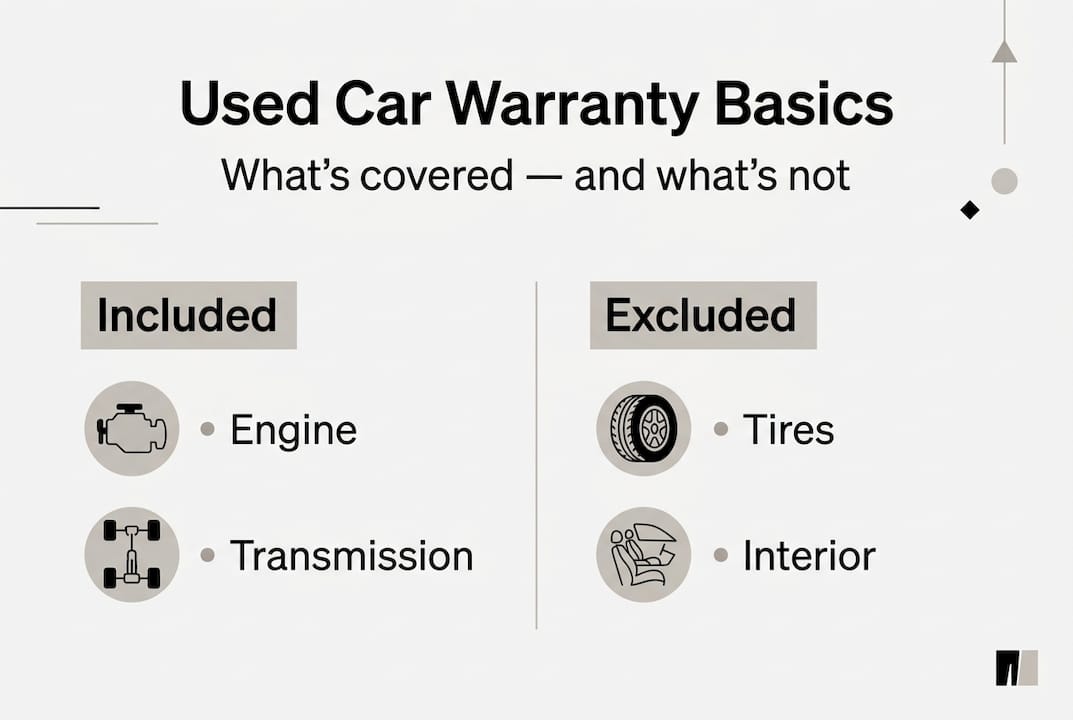
Warranty supporters rightly view extended coverage as insurance against product failure, especially when you plan to keep the car for several years. That framing is accurate. You are not betting that your car will break. You are protecting yourself from the financial consequences if it does.
The definition of auto warranty coverage also includes important details about deductibles, repair shop networks, and claim processes. These details affect the real-world value of any plan you consider.
Pro Tip: Always read the exclusions section of any warranty contract before signing. The list of what is NOT covered often tells you more about a plan's value than the list of what is.
When is buying a used car warranty a smart move?
Not every used car buyer needs a warranty. But most do. The key is evaluating your specific situation honestly before deciding.
Here are the main factors that should shape your decision:
- Your repair fund. Do you have $3,000 to $5,000 set aside specifically for car repairs? If not, a warranty fills that gap directly.
- The car's reliability history. Some makes and models are known for expensive, recurring problems. Research your specific vehicle before assuming it will be trouble-free.
- How long you plan to keep it. The longer you own a used car, the more likely something significant will need repair. Long-term owners benefit most.
- Your risk tolerance. Some people sleep fine knowing a big bill might come. Others find that uncertainty genuinely stressful. Both responses are valid.
- The vehicle's age and mileage. Older vehicles with higher mileage carry more mechanical risk by definition.
| Factor | With warranty | Without warranty |
|---|---|---|
| Peace of mind | High | Low to moderate |
| Financial risk | Capped by deductible | Unlimited |
| Coverage options | Flexible, plan-based | None |
| Upfront cost | Yes, monthly or lump sum | None initially |
Warranties are especially recommended when you lack a repair fund or plan to keep the car long term. Both conditions apply to the majority of used car buyers.
You can explore top car warranty providers to compare plans by coverage level, price, and customer ratings. It also helps to check warranties in your state since regulations and available plans can vary by location.
Pro Tip: Older vehicles and those with over 80,000 miles usually benefit most from extended coverage because the probability of a major repair rises sharply after that threshold.
Common myths and mistakes about used car warranties
Misconceptions about warranties are everywhere, and they cost buyers real money. Let us clear up the most damaging ones.
Myth 1: All repairs are covered. No warranty covers everything. Every contract has exclusions. Assuming full coverage without reading the fine print is one of the most common and costly mistakes buyers make.
Myth 2: If my car seems reliable, I do not need a warranty. Reliability history does not predict the future. Even vehicles with strong track records can develop expensive problems. Mechanical failure does not announce itself in advance.
Myth 3: Warranties are a scam. Some providers are certainly better than others, and yes, there are bad actors in this industry. But dismissing all warranties as scams means ignoring the real financial protection that reputable plans provide. The key is choosing a trustworthy provider, not avoiding the category entirely.
Many people overestimate their ability to pay for repairs or underestimate the risk. That gap between perception and reality is where financial stress lives.
Common mistakes when buying a warranty:
- Not comparing multiple providers before committing
- Choosing the cheapest plan without checking what it actually covers
- Skipping the exclusions section of the contract
- Buying from a provider with poor customer service ratings
- Waiting until something breaks to start looking
Understanding auto warranty basics before you shop puts you in a much stronger position to evaluate what you are actually being offered.
Peace of mind is not just a sales pitch. When you know a major repair will not derail your finances, you drive differently. You stress less. That psychological value is real, even if it does not show up on a spreadsheet.
Our perspective: What most guides get wrong about used car warranties
Most warranty guides reduce the decision to a simple math problem: compare the cost of the warranty against the average repair bill and see which number wins. That framing misses the point entirely.
We have seen buyers skip coverage on a vehicle that seemed solid, only to face a $4,000 repair eight months later with no financial cushion. The math looked fine on paper. The reality was brutal.
The guides that focus purely on cost also ignore something important: even the most reliable brands can fail. A Honda or Toyota with 90,000 miles is still a machine with aging components. Repair costs in 2026 are higher than they have ever been, partly because modern vehicles are more complex and partly because skilled labor is expensive.
When skipping a warranty makes sense: if you have a dedicated repair fund, plan to sell the car within a year, or are buying a vehicle known for exceptional long-term reliability with low mileage. Those are legitimate exceptions.
When it really does not make sense to skip: any other situation. The uncomfortable truth is that most used car buyers are one repair away from financial stress, and a warranty is one of the few tools that directly addresses that risk. You can compare warranty options to find a plan that fits your budget without sacrificing meaningful coverage.
Find the best used car warranty for your needs
You now understand the risks, the coverage types, and the decision factors. The next step is finding a provider you can actually trust.

At Top Ten Car Warranty Companies, we make that process straightforward. You can view top warranty providers ranked by coverage quality, customer satisfaction, and pricing, all in one place. Each listing includes the features that matter most so you are not guessing. When you are ready to move forward, you can compare warranty quotes directly and find a plan that matches your vehicle, your budget, and your coverage needs. Getting the right protection does not have to be complicated. It just takes the right starting point.
Frequently asked questions
Is it worth buying a warranty for a used car?
If you cannot comfortably afford a sudden major repair, buying a warranty is worth it. Unexpected repairs can drain savings fast, and a warranty caps your out-of-pocket exposure.
What does a used car warranty usually cover?
Most plans cover major mechanical and electrical failures like engine and transmission problems. Warranty coverage may include major breakdowns but routine maintenance and wear items like brakes and tires are almost always excluded.
Can I buy a warranty for an older or high-mileage used car?
Yes, coverage is available for older and high-mileage vehicles, but plans may cost more and offer fewer options. Older vehicles often need warranties most, so comparing providers carefully is especially important in this category.
Will a used car warranty cover everything that breaks?
No. Every warranty has exclusions, and assuming full coverage without reading the contract is a costly mistake. Many people overestimate what warranties cover, so always review the exclusions list before you buy.